
Analyzing Situational Awareness and Decision-Making: Who Is on the Safer Side?
Introduction
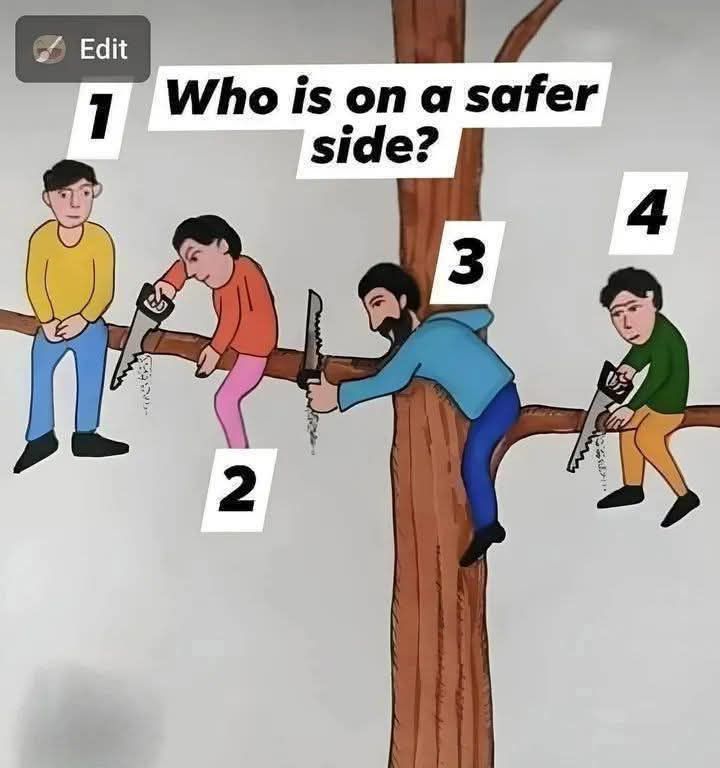
In this thought-provoking illustration, four individuals are seen engaging in actions involving tree branches, each with a saw in hand. The image asks a simple yet complex question: Who is on the safer side? At first glance, it may appear humorous or absurd, but it subtly encapsulates deeper insights into human behavior, situational awareness, and critical decision-making.
This article aims to analyze each individual’s actions and determine who among them is actually in the safest position—logically and physically.
Breakdown of Each Individual’s Position
Person 1
This individual is seated at the far left of the branch, with another person (Person 2) actively sawing the branch between them and the tree trunk. Person 1 appears unaware of the imminent danger. Once Person 2 completes the cut, Person 1 will inevitably fall. Thus, Person 1 is not safe.
Person 2
Ironically, Person 2 is sawing the branch on which they themselves are seated—on the side that is not connected to the tree. Once the sawing is complete, they will fall due to gravity and lack of support. This demonstrates a lack of foresight and awareness. Person 2 is clearly not safe.
Person 3
Positioned next to the tree trunk, Person 3 is sawing the branch on the outside, away from themselves. This means that even when the branch is severed, Person 3 will remain safely connected to the main trunk. From a purely logical and structural standpoint, Person 3 is the only one taking a safe and rational action.
Person 4
Similar to Person 2, Person 4 is cutting the branch between themselves and the tree trunk. Once the cut is completed, they will fall as the branch holding them will no longer be supported. This demonstrates poor situational awareness. Person 4 is not safe.
Conclusion: The Safest Individual
After analyzing the physical context and logical outcomes of each person’s actions, Person 3 is definitively the one on the safer side. This person is the only one demonstrating an understanding of cause and effect, ensuring their own safety while performing an action that doesn’t endanger themselves.
Broader Interpretation
Beyond the physical scenario, this illustration can be seen as a metaphor for real-life decision-making in personal and professional contexts. Many individuals take actions without fully understanding the consequences or the systems they depend on. Others may inadvertently sabotage themselves or others due to a lack of foresight.
Person 3 symbolizes the value of critical thinking, strategic planning, and informed action—qualities essential not just for safety, but for long-term success in any domain.
Key Takeaways
-
Situational awareness is critical—Understanding your position in relation to your actions can prevent self-sabotage.
-
Not all actions are productive—Just because someone is doing something doesn’t mean it’s the right thing.
-
Think before you act—A moment of reflection can save you from irreversible consequences.
