
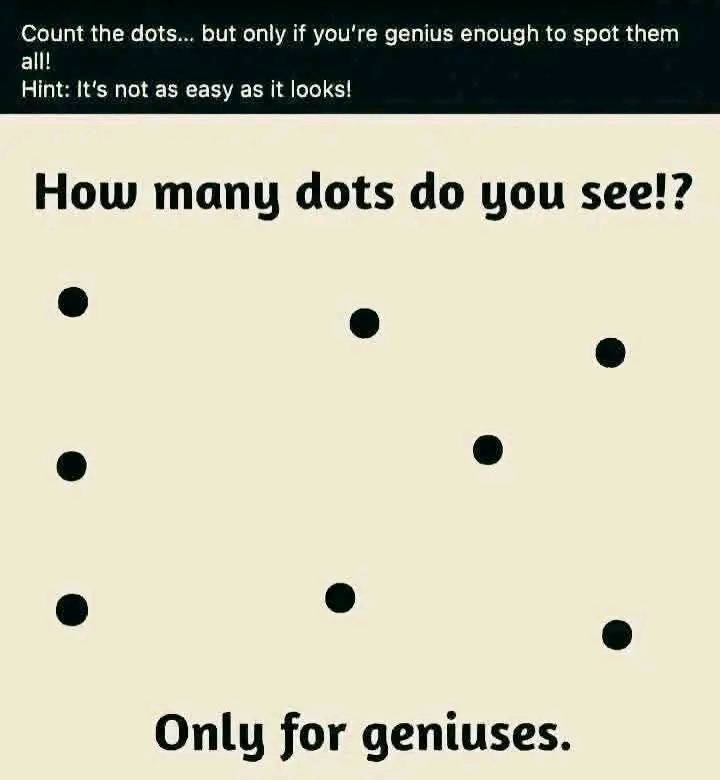
👁️🗨️ The Science of Visual Perception
The illusion is rooted in how our visual system processes contrast, light, and spatial relationships. When multiple high-contrast elements are placed close together—like black dots on a light background—our neurons struggle to maintain a stable image. This leads to a phenomenon known as lateral inhibition, where the presence of surrounding stimuli suppresses the perception of nearby elements.
In simpler terms: your brain is trying to filter out “noise,” but ends up filtering out the dots themselves.
🧩 Why Intelligence Has Nothing to Do With It
Despite the image’s claim that “only geniuses” can spot all the dots, the truth is more democratic. This illusion doesn’t test intelligence—it tests perception. And perception is shaped by biology, not IQ. Even seasoned neuroscientists fall for it.
However, puzzles like these do serve a purpose: they remind us that our senses are not infallible. They’re interpretations, not recordings.
🔍 What It Reveals About You
If you find yourself frustrated by the puzzle, take heart. Your brain is doing exactly what it’s designed to do—filtering, simplifying, and prioritizing information. In fact, illusions like this are used in cognitive research to study attention, memory, and even disorders like schizophrenia or ADHD.
So the next time you’re tricked by a dot that disappears, smile. You’ve just witnessed your brain in action.